Confused?

Me too... but you can be helped by reading my intro post.
Showing posts with label DNA. Show all posts

Monday, May 28, 2012

Lean, green protein-making machines


When researchers become enamored of a particular protein and want to study it, one of the first things they do is figure out how to get their hands on a LOT of it. That way, they can put it in test tubes, add and subtract different chemicals and alter the conditions and environment (temperature, pH, etc.) to figure out what really makes the protein act the way it does.
It may seem reasonable to suggest that these researchers just go collect the protein from its natural source. After all, the organism that produces the protein must be pretty good at it, right?
Ok, so if a researcher is studying a human protein, they can come after you with a needle for regular plasma draws or have you pee in a cup and filter out the protein from your fluids… but what happens if they are studying a protein that you pretty much suck at making, that is made in a few different varieties depending on whether or not you’re healthy or sick, that isn’t found in your blood or urine? Would you want researchers to come after you to extract, for instance, GREB1, which is found in prostatic tissue and prostate cancer? Probably not…
guyism.com
But there is good news for you and your prostate: scientists have been making proteins in the lab for a long time! (Time out: if you need a little DNA/protein tutorial, go on back to my DNA 101 post). So what is the recipe for a protein?
1.     Take the DNA sequence that codes your protein and put it into an organism that won’t care if you’re all up in its prostrate
2.     Turn that organism into a protein factory, letting it churn out millions of copies of your protein
3.     Isolate—filter—your protein out of all the other gunk
4.     Viola! You now have gobs of your favorite protein to use to your heart’s content
Ok, so of course some of these steps are a little more complicated than just waving a magic science wand. In fact, I hear a stampede of grad students (my younger self included) at my door, ready to skewer me for compacting years of blood, sweat, and tears into a few flippant bullet points. 

talkandroid.com
 But the important technological advance here is to hijack a biological system in order to do your heavy lifting.
What are the types of critters scientists use as their workhorses? Usually bacteria and yeast; sometimes insect, plant, or mammalian cells that can live in culture. The key property is that these cells grow quickly and robustly and merrily make protein, even protein that it wouldn’t normally make from the extra gene that you put into it.
And that, my dears, is how you make perfect protein every time! (how do you type a Julia Child voice?) apronstrings.com


So, if this technology has been around for a long time and is the part of the Materials and Methods section in a scientific paper that gets glossed over (unless you’re one of those grad students trying to do the same thing), why am I going on and on about it?
Honestly, this in and of itself isn’t something I’d normally find inspiration in to write about, other than the fact that I love keeping up on malaria research.
The reason I found this study so interesting is the fact that in all my various E-mail subscriptions and Twitter feeds and Facebook updates, I kept reading about it! Sure, the fact that they used algae is kind of cool, but scientists are always trying to find the best organism to use to get the most protein they can. So why was it everywhere?
Marketing! That’s how! This study is a perfect case study of knowing how to make your story sexy. I don’t know if these researchers have a publicist or what, but seriously, it’s brilliant: use the algae to produce a protein that could potentially be a MALARIA VACCINE TARGET, and suddenly you’ve got an angle. Now, instead of a headline (that would never be written because it’s boring) reading “Researchers Add Another Organism to a Long List of Things That Can Make Protein in the Lab,” they get ones like “Biologists Produce Potential Malarial Vaccine from Algae." Much better.
I don’t want to trivialize the importance of this study, nor do I want to make it sound like they’re undeserving of the press. I personally think this is really freaking cool, based on the fact that I did my thesis project on malaria and on the fact that it’s a prime example of how scientists can make their work accessible to the general public. They do not say they have cured the disease or found a vaccine; instead, they have given their finding potential context and a reason for people to care.
And giving people a reason to care and instilling in them passion is, in my opinion, where science communication often falls flat.
So, kudos to Stephan Mayfield and his team for their success and for being an example of how you can do good science, do science well, and write about both for your fellow scientists and for the general public.

Sunday, February 26, 2012

The Devil May Care


February Journal Club
I’m guessing that when most people think of the Tasmanian Devil, they think of this guy: 

That loveable, cuddly (ok, maybe not so much) character from the Warner Bros. Looney Tunes cartoons.
The cartoon “Taz” had quite the appetite and left a path of destruction in his wake. His real-life cousins, the species Sarcophilus harrisii, are not so destructive or slobbery – and their particular taste for rabbits may not be clear – but they are carnivorous, speedy, and just about as cute.
http://upload.wikimedia.org/wikipedia/commons/4/43/Sarcophilus_harrisii_taranna.jpg
And, unlike the Taz this will be forever immortalized in cartoon form, the real-life Tasmanian devils are doomed: Taz’s cousins are becoming extinct because of cancer.
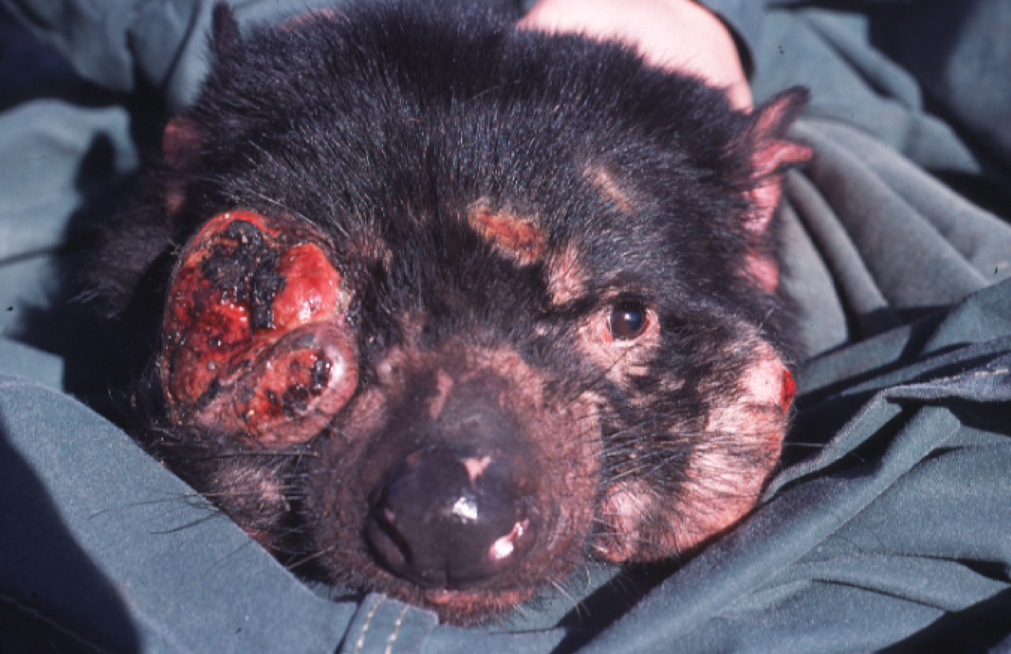
More ferocious than the devil itself is Tasmanian devil facial tumor disease (DFTD). This cancer causes disfiguring tumors on the faces of Tasmanian devils and interferes with their ability to eat, so infected devils actually die of starvation and not from the cancer directly. 
http://upload.wikimedia.org/wikipedia/commons/9/99/Tasmanian_Devil_Facial_Tumour_Disease.png
This cancer was first observed in 1996 and has quickly spread throughout the population of devils on the island of Tasmania, which is part of Australia. In 2006, a very important observation revealed the most unique characteristic of DFTD tumors: the tumor cells did not come from host animal.
Why is this so revealing? In most cancer types, tumors form because cells of the host somehow go awry. Even if something from the outside world causes the cancer (UV rays, smoking, human papillomavirus), the original source of the tumor is from the host, meaning that the DNA content of the tumor is the same as that of the host. Not exactly the same – there has to be at least one mutated gene otherwise it would be a normal cell and not a tumor cell – but close enough that if the DNA sequences of the host and tumor were compared, it would be clear that the tumor came from the host.
DFTD is different. In 2006, scientists found evidence that the DNA sequence from a tumor did NOT match that of its host, meaning the tumor cells had to come from elsewhere: another animal. And sure enough, the animals were giving each other cancer through the normal biting that occurs during mating and feeding. These tumor cells would essentially graft (stick) themselves onto the face of the victim of the bite and multiply there. The relative ease with which this occurs explains the rapid spread of DFTD throughout the Tasmanian devil population.
So, basically, DFTD is the vampire of the cancer world: it is immortal. Other cancers usually die with their host. Not DFTD: it lives on in the newly infected animals. Even though the first devil with the first case of DFTD has long since died (devils only live 5-6 years), that first tumor has essentially been cloned and started over with each new infection. As happens over time (think evolution), each clone may be slightly different than other clones due to random mutations, but all are variants of the same original tumor. To draw a comparison: when a human cancer metastasizes, or moves, it stays within the original host and moves from, for example, the breast to the lymph nodes. DFTD, though, metastasizes from one animal into another.
This property of being transmitted from animal to animal has wreaked havoc on the devil population but can also be used by researchers to study DFTD in the hopes of combating it. Instead of having to study this tumor in the lab, the devil population acts as a natural incubator, keeping the tumor cells alive indefinitely. By comparing the DNA sequences of normal devils to the sequences of present-day DFTD tumors, the following key questions can be studied:
1.     What makes the tumor cells different than normal devil cells and how is it able to cause disease?
2.     How has the cancer changed over time from the initial founder to the different lineages now found in nature?
3.     How did the cancer spread from one devil to the entire devil population?
These are precisely the questions raised by a group of researchers when they set out to sequence the genome of the Tasmanian devil and different DFTD tumors (Murchison EP, et al. (2012). Genome Sequencing and Analysis of the Tasmanian Devil and Its Transmissible Cancer. Cell 148(4): 780-791).
How can sequencing the genome of an animal and its cancer cells reveal so much about the history of the disease and how it works? It all has to do with comparing different sequences and analyzing what must have happened over the course of time to cause these changes.
Three genomes were sequenced: a normal, adult female devil and two tumors from different parts of Tanzania (in the paper, these are called the titillating names of 87T and 53T). The two tumors have undergone random mutations since they diverged from the original DFTD tumor. By comparing these mutations to each other, researchers can estimate what changes occurred after the tumors left the original host. If both 87T and 53T have the same mutation in gene X, this mutation probably was in the original tumor because it is not statistically likely that both tumors would separately have the exact same mutation in the exact same place. (Consider these odds: if the tumor DNA genome is about 3 billion units in size, then the chance of an identical mutation in 2 different genomes is a 1/3,000,000,000 x 1/3,000,000,000 = 1 in 9,000,000,000,000,000,000 chance. Take those odds to Vegas!)
By identifying the mutations present in the tumors and not in the normal devil genome, the original tumor DNA sequence could be deduced. Then, by comparing the tumor genome to the normal devil genome, the differences that make the normal cells “normal” and the tumor cells “tumorigenic” were revealed. For example, mutations were found in genes that are related to cancer in humans. Also, mutations were found in genes that would allow the tumor to “hide” from the host immune system, a property it has to have to be able to survive on the face of a devil.
Once the researchers identified where the differences were in the sequences of the two tumor genomes, these “hotspots” could be identified in hundreds of tumors throughout Tanzania. A sort of family tree was constructed to trace the spread of DFTD from the original devil to its present widespread distribution – a history of the disease.
Understanding the past development of DFTD is academically interesting, as is knowing what the original tumor “looked” like, but there are further implications beyond just basic curiosity. By knowing how DFTD evolved in the past, scientists can predict how it may change in the future and act to target these changes to prevent or stop the disease. Furthermore, there are still ways in which the data from this study can be analyzed. For instance, even though mutations were found in certain genes, the “how” question has not been answered: how these mutations cause DFTD. So far, only genes that are known to play a role in human cancers have been probed for the presence of mutations, but others could possibly be involved.
DFTD is well on its way to causing the extinction of an entire species. Understanding how the tumor cells are different than normal cells is key for developing therapy to cure or prevent DFTD. One other cancer is caused in the same way as DFTD (that is, is immortally transmitted through bites): a cancer of dogs, called canine transmissible venereal tumor (CTVT). The lessons learned from DFTD may be relevant to CTVT. So, if the soft spot in your heart for Taz isn’t big enough, think of Fido.