Confused?

Me too... but you can be helped by reading my intro post.
Showing posts with label sequencing. Show all posts

Saturday, March 17, 2012

I can haz medicines?


The concept of personalized medicine seems to be trending as one of the “next big things” when it comes to advances in medical treatment. The principle is simple: each individual has a different genetic background, so everyone will have a slightly different susceptibility to different diseases or different responses to different treatments. Basically, the same reasons that make me a 5’4” white female with athletic build and brown eyes (call me!) and you something else – our genes – are the same reasons that we may each develop a different kind of cancer, need different doses of pain medication (or alcohol) to take care of a headache, or have different symptoms when exposed to the same allergen or flu virus. (Yes, there are environmental factors involved. But I would argue that even those, eventually, come back to the genes – the way the body responds is all about the genes).
There are tests currently available that can identify specific genetic markers (for example, the so-called “breast cancer gene,” BRCA) that are used by physicians to advise treatment or preventative courses of action. In fact, testing kits can be mailed to any curious individual – simply swab your cheek, send your spit to a testing company, and you will be provided with your very own genome sequence! Of course, what you do with that information is slightly unclear (and controversial), so it seems more prudent to get your doctor somehow involved in things that involve, you know, your health.
A recent push for developing relatively fast and cheap methods to sequence genes has led to a huge increase in technology to make whole-genome sequencing technically possible for laboratories. That said, the day of submitting a blood sample to your doctor to be run through a machine and immediately spitting out your own personal profile is far away. Which is probably a good thing; I’m not sure health insurance as we know it would be able to handle it (as opposed to the stellar job it does now).
Another wrinkle in the whole personalized medicine concept is the fact that it’s not just a patient’s genes that are important. Your genes make all the bits and pieces of your cells that make up you – and it’s not uncommon for, say, a protein to be affected without there being a difference in the gene that makes that protein. So, tests wouldn’t just need to decipher your genetic makeup, but also the make up of all those “bits and pieces.” This is where the field of “omics” comes in.
“Omics” has turned into a catch-all suffix that basically means “all the things" and, when applied rigorously, how all these things interact. Genomics = all the genes and how they interact with each other. Proteomics = all the proteins and how they interact with each other. Proctrastanomics = all the stuff you were supposed to be doing while you played Words with Friends and how that interacts with the likelihood of you being productive. Like any meme that infiltrates the internet – cat videos, “Shit so-and-so says,” and Tebow-ing spoofs – the “omics” suffix causes varying degrees of reactions, from the exuberant “OMG that's so awesome, ROTFL!” to the more subdued “LOL” to the outright annoyed “WTF I’m blocking your posts.” Count me in the camp that thinks that “omics” tends to be overused and misused as a buzzword. I mean, “Pharmacomicrobiomics investigates the effect of variations within the human microbiome on drugs.” Seriously?
However, when used correctly, the concept can be powerful, as it was in the recent Cell publication by Rui Chen and colleagues. This study analyzed various “omics” of one individual over 14 months to see how all those bits and pieces changed over time. (I say individual and not patient because the subject was healthy and not hospitalized.) The scientists tested the individual’s blood for what genes were turned on and off, what proteins were being made, what antibodies were being produced, and what metabolic processes were occurring. During the course of the study, the individual had a couple of infections and developed signs being at risk for Type 2 diabetes.
(Parenthetically, after the study was published, the subject revealed himself to be the lead investigator of the report, Dr. Michael Snyder of Stanford. He now joins the ranks of such self-experimentalists as Jonas Salk, who gave himself the polio vaccine, Albert Hoffmann, who synthesized and then took LSD, and Dr. Jekyll, who transformed himself into Mr. Hyde.)
Throughout it all, a picture of the subject’s “omic” profile was painted (referred to as iPOP – talk about a meme), revealing the potential strength this kind of analysis would have in personalized medicine. The fact that the subject began the study healthy was also of interest: not only should patients be analyzed after becoming sick, but the normal workings of a person’s “omics” should also be monitored – the onset of diabetes in the experimental subject may not have been observed if not for this study. The analysis also showed what happened to the “omic” profile over the course of an infection and treatment regimens, which also provides information as to how the infections progress and how they can be treated most effectively.
Now, we can’t all have a group of dedicated scientists analyzing our blood for all these bits and pieces every day. Even though the costs of doing such analyses are decreasing, spending a few thousand dollars every time one of the tests is run is still not exactly chump change. That, and it’s not like you can just call up these guys and have them repeat all of this on your blood. They probably have other things to do. But, this study is a fantastic proof-of-principle of the potential value of acquiring this amount of data from individuals.   


Sunday, February 26, 2012

The Devil May Care


February Journal Club
I’m guessing that when most people think of the Tasmanian Devil, they think of this guy: 

That loveable, cuddly (ok, maybe not so much) character from the Warner Bros. Looney Tunes cartoons.
The cartoon “Taz” had quite the appetite and left a path of destruction in his wake. His real-life cousins, the species Sarcophilus harrisii, are not so destructive or slobbery – and their particular taste for rabbits may not be clear – but they are carnivorous, speedy, and just about as cute.
http://upload.wikimedia.org/wikipedia/commons/4/43/Sarcophilus_harrisii_taranna.jpg
And, unlike the Taz this will be forever immortalized in cartoon form, the real-life Tasmanian devils are doomed: Taz’s cousins are becoming extinct because of cancer.
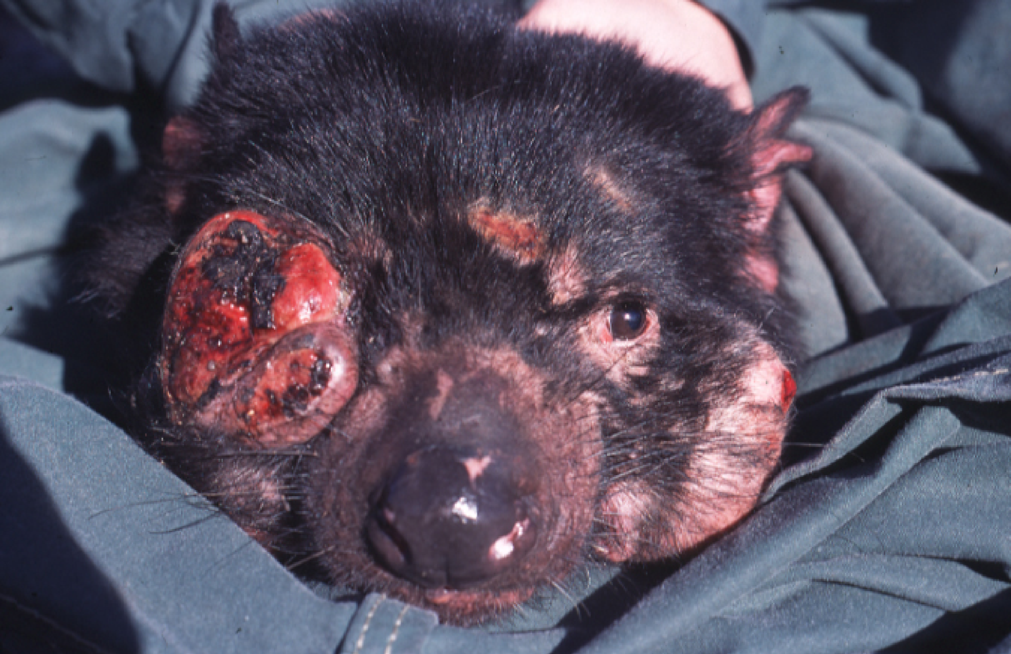
More ferocious than the devil itself is Tasmanian devil facial tumor disease (DFTD). This cancer causes disfiguring tumors on the faces of Tasmanian devils and interferes with their ability to eat, so infected devils actually die of starvation and not from the cancer directly. 
http://upload.wikimedia.org/wikipedia/commons/9/99/Tasmanian_Devil_Facial_Tumour_Disease.png
This cancer was first observed in 1996 and has quickly spread throughout the population of devils on the island of Tasmania, which is part of Australia. In 2006, a very important observation revealed the most unique characteristic of DFTD tumors: the tumor cells did not come from host animal.
Why is this so revealing? In most cancer types, tumors form because cells of the host somehow go awry. Even if something from the outside world causes the cancer (UV rays, smoking, human papillomavirus), the original source of the tumor is from the host, meaning that the DNA content of the tumor is the same as that of the host. Not exactly the same – there has to be at least one mutated gene otherwise it would be a normal cell and not a tumor cell – but close enough that if the DNA sequences of the host and tumor were compared, it would be clear that the tumor came from the host.
DFTD is different. In 2006, scientists found evidence that the DNA sequence from a tumor did NOT match that of its host, meaning the tumor cells had to come from elsewhere: another animal. And sure enough, the animals were giving each other cancer through the normal biting that occurs during mating and feeding. These tumor cells would essentially graft (stick) themselves onto the face of the victim of the bite and multiply there. The relative ease with which this occurs explains the rapid spread of DFTD throughout the Tasmanian devil population.
So, basically, DFTD is the vampire of the cancer world: it is immortal. Other cancers usually die with their host. Not DFTD: it lives on in the newly infected animals. Even though the first devil with the first case of DFTD has long since died (devils only live 5-6 years), that first tumor has essentially been cloned and started over with each new infection. As happens over time (think evolution), each clone may be slightly different than other clones due to random mutations, but all are variants of the same original tumor. To draw a comparison: when a human cancer metastasizes, or moves, it stays within the original host and moves from, for example, the breast to the lymph nodes. DFTD, though, metastasizes from one animal into another.
This property of being transmitted from animal to animal has wreaked havoc on the devil population but can also be used by researchers to study DFTD in the hopes of combating it. Instead of having to study this tumor in the lab, the devil population acts as a natural incubator, keeping the tumor cells alive indefinitely. By comparing the DNA sequences of normal devils to the sequences of present-day DFTD tumors, the following key questions can be studied:
1.     What makes the tumor cells different than normal devil cells and how is it able to cause disease?
2.     How has the cancer changed over time from the initial founder to the different lineages now found in nature?
3.     How did the cancer spread from one devil to the entire devil population?
These are precisely the questions raised by a group of researchers when they set out to sequence the genome of the Tasmanian devil and different DFTD tumors (Murchison EP, et al. (2012). Genome Sequencing and Analysis of the Tasmanian Devil and Its Transmissible Cancer. Cell 148(4): 780-791).
How can sequencing the genome of an animal and its cancer cells reveal so much about the history of the disease and how it works? It all has to do with comparing different sequences and analyzing what must have happened over the course of time to cause these changes.
Three genomes were sequenced: a normal, adult female devil and two tumors from different parts of Tanzania (in the paper, these are called the titillating names of 87T and 53T). The two tumors have undergone random mutations since they diverged from the original DFTD tumor. By comparing these mutations to each other, researchers can estimate what changes occurred after the tumors left the original host. If both 87T and 53T have the same mutation in gene X, this mutation probably was in the original tumor because it is not statistically likely that both tumors would separately have the exact same mutation in the exact same place. (Consider these odds: if the tumor DNA genome is about 3 billion units in size, then the chance of an identical mutation in 2 different genomes is a 1/3,000,000,000 x 1/3,000,000,000 = 1 in 9,000,000,000,000,000,000 chance. Take those odds to Vegas!)
By identifying the mutations present in the tumors and not in the normal devil genome, the original tumor DNA sequence could be deduced. Then, by comparing the tumor genome to the normal devil genome, the differences that make the normal cells “normal” and the tumor cells “tumorigenic” were revealed. For example, mutations were found in genes that are related to cancer in humans. Also, mutations were found in genes that would allow the tumor to “hide” from the host immune system, a property it has to have to be able to survive on the face of a devil.
Once the researchers identified where the differences were in the sequences of the two tumor genomes, these “hotspots” could be identified in hundreds of tumors throughout Tanzania. A sort of family tree was constructed to trace the spread of DFTD from the original devil to its present widespread distribution – a history of the disease.
Understanding the past development of DFTD is academically interesting, as is knowing what the original tumor “looked” like, but there are further implications beyond just basic curiosity. By knowing how DFTD evolved in the past, scientists can predict how it may change in the future and act to target these changes to prevent or stop the disease. Furthermore, there are still ways in which the data from this study can be analyzed. For instance, even though mutations were found in certain genes, the “how” question has not been answered: how these mutations cause DFTD. So far, only genes that are known to play a role in human cancers have been probed for the presence of mutations, but others could possibly be involved.
DFTD is well on its way to causing the extinction of an entire species. Understanding how the tumor cells are different than normal cells is key for developing therapy to cure or prevent DFTD. One other cancer is caused in the same way as DFTD (that is, is immortally transmitted through bites): a cancer of dogs, called canine transmissible venereal tumor (CTVT). The lessons learned from DFTD may be relevant to CTVT. So, if the soft spot in your heart for Taz isn’t big enough, think of Fido.